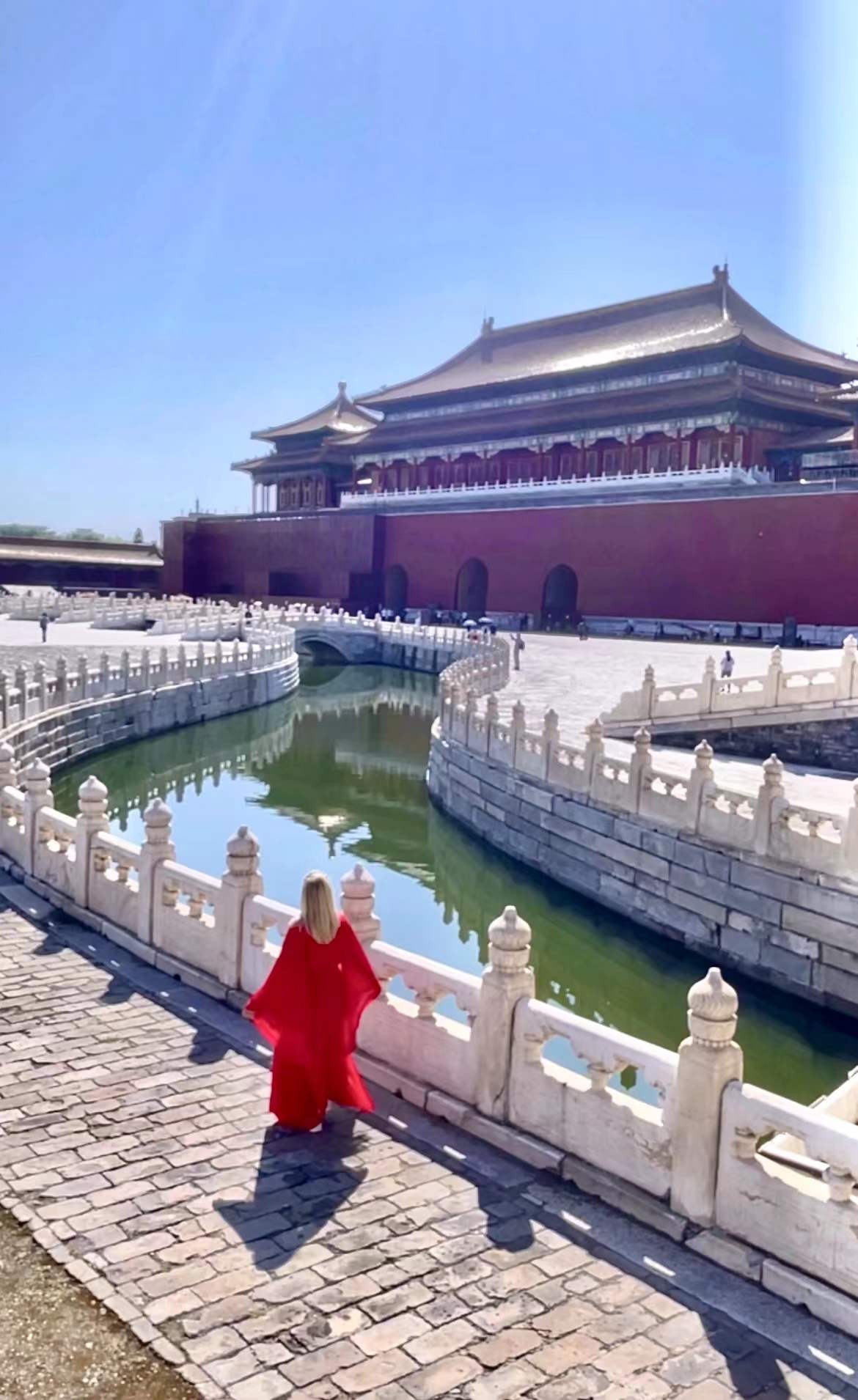
After four and a half years working as a travel host and editor in China Global Television Network’s (CGTN) Culture Department, I’m closing this chapter and beginning a new one. Before moving forward, I wanted to share some reflections on what this journey has meant to me and lessons I learned along the way. (And spoiler: I’m not leaving China yet!)
I first moved to China in 2015 with a degree in media and little knowledge of China, and these past ten years have taken me all over – from teaching in Hunan to living in the giant southern city of Guangzhou, and eventually settling in northern capital Beijing. Along the way, I’ve worn many hats and taken on different roles, each one shaping my perspective and deepening my connection to this country. Working as a travel host with CGTN has been one incredible chapter in that journey—a chapter filled with stories, people, and places I’ll never forget.


Over the last 4.5 years, I traveled to over 13 provinces, appeared in dozens of livestreams, produced and edited 200+ videos, hosted several documentary series and special projects, and took part in major gala events for the Spring Festival, Dragon Boat, Qixi, and Lantern Festival.
But this isn’t my LinkedIn resume—let me actually share some of the experiences that made this journey unforgettable!
Note: I’ve shared some short snippets of work experiences before, but I rarely talked about them in detail because this work was part of my professional role at CGTN, not my personal platforms. My blog and social media brand Rachel Meets China has always been independent and focused on my own projects, as they have always been since I came to China in 2015. But these professional experiences have shaped my time in China in meaningful ways, which is why I wanted to share a closer look at what this chapter has been like for me.


Highlights from years as a China Travel Host
When I joined CGTN in January 2021 as part of the China Plus team as a travel host, I stepped into a role that allowed me to do what I love most—tell stories about culture and people. Over the years, I’ve had the privilege to host documentaries, livestreams, and cultural programs for CGTN and CMG platforms, connecting Chinese traditions with audiences around the world.
My job took me beyond Beijing to destinations all across China, exploring culture, traditions, food, and the stories of people I met along the way. From filming in ancient villages and megacities to hiking through breathtaking landscapes, every assignment brought something new.

My First Travel Documentary Series & What It Taught Me
My first documentary series, the Old Masters of China (老手艺新生活), introduced me to the world of traditional craftsmanship in China and the world of being a travel host. I met 10 craftsmen around Anhui, Gansu, Shandong, and Beijing—learning all kinds of crafts like making Xuan paper, the centuries-old paper used for calligraphy and painting, and seeing how oilcloth umbrellas are still handmade by artisans in Anhui.

This was a full documentary series, where I traveled around with 3 different crews commissioned to complete the series. I was very new to hosting and learned so much about the behind-the-scenes process of these kinds of shoots. This was way different than making my own blogs, videos, or Instagram posts – it was working with an entire team and crew.
Honestly it was really challenging for me in the beginning – I had never been a host in this kind of way. The whole project was centered around me as the central storyteller – introducing these craftsmen to a foreign audience. I had a lot of pieces to camera where I needed to memorize a lot of facts and names, which wasn’t my strong suit. Working with 3 different crews also meant rebuilding relationships. Once I started to get into a groove with a director and crew, the project was over and I had a new group the next time.


This series also showed me that while being a travel host might sound glamorous – and of course, it is a very cool job that I feel very grateful for! – it’s not the same as a holiday or trip you would plan for yourself.
My first time I went to Gansu province was to try the famous Lanzhou beef noodles and make a video with the master there. When I returned from the trip people asked me how was the trip and if I got to see much of Lanzhou city. But the reality was we were filming in one noodle shop for 14 hours to get the episode done – time was of the essense. Hey, I did get to eat 3 bowls of their noodles and they were super delicious, but I wasn’t just traipsing around the city for fun doing what I wanted to do.

In your down time you are also prepping for the next day, doing researching, writing outlines, and practicing pieces to camera. And what might feel like a long 14 hours day for me is an even longer day for the film crew and director.
They stay up late to back up footage, review video takes from the day, and recharge equipment, and in the morning, while I’m getting hair and makeup done, they are packing the van and preparing equipment for the day. You wouldn’t believe how many extra batteries they would carry with them as well- you can never be too prepared!


Another funny thing is learning about camera dynamics and interview subjects – I was new to this role, but familiar with media and being on camera. These Old Masters were excellent craftsmen and very knowledgeable, but knowing a subject is also different than presenting it on camera.
When asked about their technical trades, the masters would give answers that would be way too long and complicated for the video length, and would be even more difficult to understand when translated to English for a foreign audience. Some of the directors handled this really well by prepping the masters in advance – we would run through the scene, what questions I would ask, and the scope of answers to give. Having a director know how to set that up really helped vs. some who tried to wing it and we ended up having to shoot over and over again.


Festivals and Traditions
After that first hosting experience, I felt much better about future documentaries and livestreams. I learned how to navigate being a host, how to prepare, how to convey messages to a foreign audience.
Much of my job meant experiencing Chinese festivals firsthand across the country, and seeing how different provinces might have different ways to celebrate.
I saw Spring Festival traditions with fish lanterns in Puyuan Ancient Town, learned Duanwu traditions in Qu Yuan’s hometown of Yichang with a dragon boat racing team, and tried Ming Dynasty-style Hanfu (actually, I’ve tried many types of Hanfu many times over the years!)


I also hosted several livestreams with Ji Xiaojun 季小军, a well-known bilingual host. From tasting Spring Festival treats to exploring art shows, these sessions were always fun, spontaneous, and a great way to share Chinese culture with viewers in real time.
I really liked working with him as he was a pro – as a host for decades, I could see how he had high energy and connected with audiences in real time. He really enjoyed what he was doing and relaxed into it, rather than getting caught up in the logistics and keeping the whole outline in my head like I was doing in the beginning.


Travel and Exploration
My role took me all across China: from the Tibetan grasslands of Xinduqiao and the breathtaking Yading Nature Reserve in Sichuan, to the Mogao Caves in Dunhuang, Gansu where I filmed a TV piece for CGTN The Vibe: Silk Road Cultural Expo.
China is a vast country with diverse provinces, each with its own unique culture and cuisine. While Putonghua, or Standard Mandarin, is the official language spoken nationwide, regional dialects vary greatly from one area to another. This sometimes led to funny moments on shoots—like when we visited rural parts of Fujian or Anhui, and even my colleagues from Beijing struggled to understand the local dialect. It was a reminder of just how linguistically rich and diverse China really is.


My Second Documentary Series: Hubei Province Travel
For my second full series, I traveled to Hubei Province in 2021 for a joint project between CGTN and the Hubei Tourism Bureau.
We spent time with local people, from students at Wuhan University to see the famous Cherry Blossom Avenue, to local legends who swim across the Yangtze Rive every morning in Wuhan – even when it’s cold outside!
We also filmed at the Sakura Garden inside the Wuhan East Lake, and ate reganmian 热干面 for breakfast, the famous Hubei hot and dry noodles. Busy traders and business people who hurry to their jobs in the morning may not have enough time to prepare breakfast at home, so they often buy quick eats at street food stalls. This became “Guo Zao” (which means to have breakfast).


CCTV Spring Festival Gala
I participated in CCTV’s Spring Festival Gala in 2022, joining the chorus for the Winter Olympics theme song Light Up Dreams, and later appearing in the Lantern Festival Gala in 2025.


Conferences and Media Events
I attended the “China Up Close 一起看中国”福建行” Fujian Tour with CGTN, where we visited cultural sites and business enterprises in Fuzhou, Kuliang, Ningde, Pingtan, Quanzhou. The tour was arranged with many journalists from Asia Pacific countries who were doing exchanges in China.


I went to the Bond with Kuliang: 2024 China-U.S. Youth Festival in Fujian (2024年“鼓岭缘”中美青年交流周). It was an honor to meet Tang Wenshen 唐闻生, an American-born Chinese diplomat. She played an important role during U.S. President Richard Nixon’s historical 1972 visit to China.
It was also so cool to connect with many U.S. students, organizations, and educators to have conversations about the importance of US-China people to people exchanges.


I also attended the Hainan Island International Film Festival in December 2024, and spoke at this year’s 2025 中关村论坛 ZGC Forum, discussing Beijing’s support for global talent and innovation. (2025 Beijing International Youth Innovation and Development Forum 北京国际青年创新发展论坛)
In my speech, “7 Years in Beijing: Finding Community, Opportunity, and Balance”《在北京的七年:寻找归属、机遇与生活平衡》, I shared my journey as an American media professional in Beijing since 2018 and how Beijing fosters growth, opportunity, and connection.


What I’ve Learned Over 4.5 Years as a Travel Host in China
Hosting for international TV, live streaming cultural events, and producing digital content taught me so much—about adapting to different media formats, working with diverse teams, and communicating Chinese culture in ways that resonate with audiences worldwide. It wasn’t always easy, but every challenge was a chance to grow.
Every trip introduced me to extraordinary people—tea pickers, paper makers, candy artisans, local chefs, journalists, cultural diplomats,—and reminded me why I love cultural storytelling. There are way more experiences I’ve had over the years, but it’s impossible to mention them all or it would make this blog even longer than it already is!

A phrase you’ll often hear is that China has 5,000 years of history—and it’s true. There’s an incredible depth of culture, stories, and traditions to explore. As hosts and storytellers, our job is to learn as much as we can, often in a short amount of time, and then share that knowledge with others. We rely on experts to guide us, and it’s essential to strike a balance: showing respect for the culture and its heritage while making it engaging and accessible for a global audience. Here are some tips that helped me along the way.
Just a note: these are my personal experiences, especially making English video content for an international audience to learn more about China. I also attended several media trainings run by other international presenters, which I learned from and used. These are not hard and fast rules or guidelines, just tips that helped me in my specific role.

1. How to Tell Cultural Stories for a Global Audience
The ultimate media and marketing golden rule: know your audience.
My job with CGTN Culture was to find ways to share Chinese traditions in a way that feels authentic and engaging for viewers from international backgrounds. This means being mindful of presentation and references, while still staying true to Chinese history or culture.
If I were working for a domestic CCTV channel for Chinese audiences, our messaging style would be completely different.

2. How to be a better international presenter/host:
✅ Presenter Dos
- Be a great tour guide: Knowledgeable, relatable, and a strong storyteller. Follow the KISS principle (Keep It Simple, Stupid). Make the audience feel your enthusiasm—it’s infectious.
- Be prepared: Have at least 20 facts ready. Use relatable analogies to help viewers connect with the story:
- Instead of just saying “during the Tang Dynasty,” give references like “around the same time as the European Renaissance.”
- Avoid absolutes like “the deepest,” and say “one of the deepest—about as deep as two Eiffel Towers stacked together.”
- Replace trivia with context: Instead of “How many bricks are in the Great Wall?” say “It’s the longest man-made structure in the world—2,500 km, the distance from Europe to Moscow.”
- Be the best version of you:
- Warm up physically—jumping jacks can help you loosen up and feel energized.
- Imagine talking to a friend, not lecturing a class. Be genuine, not robotic or professorial.
- See the camera as your friend—it’s small, it’s there to listen. Slow down, be present, and speak confidently.
- Channel that energy you have when you’ve just told a killer joke and everyone’s laughing—own the room.
- Keep it short and impactful:
- Stand-ups should be 30–45 seconds.
- Voiceovers should add insight that isn’t obvious on-screen—don’t narrate what the audience can already see.
- Bring scenes to life:
- Keep a diary of sounds, feelings, textures, and colors to make your descriptions 3D.
- Let the viewer experience the moment through you—you’re their representative on the journey.
- Build rapport with guests:
- Ask open-ended questions (what, why, how) instead of yes/no questions.
- Use silence—don’t interrupt; it often leads to better stories.
- Make it a conversation, not an interrogation.
- Remember the audience: Even with a cohost, you’re also talking to viewers—include them in the experience.

❌ Presenter Don’ts
- Don’t assume knowledge: Spell things out clearly. For example: Gunpowder, paper, printing, and compass are China’s Four Great Inventions. You might assume that this is common knowledge, but some people may not know.
- Don’t make sweeping statements: Avoid phrases like “the number one under heaven” or “a marvelous 5,000 years of history”—it sounds propagandistic to an international audience.
- Don’t alienate or overload your audience: Keep language simple, avoid jargon, and break down complex ideas into digestible pieces.
- Don’t be patronizing or overly academic—keep it conversational and relatable.
- Limit complex names: Max one Chinese name every 30 seconds and put it on a map for context.
When writing scripts, I often saw intros that packed in every administrative level—Province, County, City, and Village. While this is accurate, it can overwhelm an international audience unfamiliar with Chinese geography and lose their attention. A great host and friend of mine told me: edit that down to what matters most.
Bad Example: “Tin inlaying is an ancient craft and an intangible cultural heritage originating from Chishan Town, Wendeng District, Weihai City, located in Shandong Province in eastern China.”
This is factually correct but too heavy and hard to follow for someone new to China, who has no idea where this place is.
Edited Example:
“Tin inlaying is an ancient craft and an intangible cultural heritage of Weihai, a city in northeast China’s Shandong Province. It’s a decorative art form where tin patterns are inlaid on pottery and other materials.”
The edited version is shorter, keeps the essential context, and is easier for global audiences to understand. Even better, you could visually use a map to show where this is.

3. The Art of Cultural Translation
Cultural translation is more than converting language—it’s about understanding context, symbolism, and meaning, especially when presenting Chinese culture to an international audience.
Many of the scripts I worked with were originally written in Chinese. Chinese is highly descriptive and poetic, particularly when describing history, landscapes, or intangible cultural heritage. It sounds beautiful in Chinese—but when translated literally, it often feels awkward or overly formal in English.
Chinese also uses chengyu (idioms) that can express profound ideas in four characters—something that might take several sentences in English. If translated word-for-word, it often sounds confusing or stiff. A good presenter adapts these ideas into natural English, preserving the meaning and elegance without losing the audience. I would often ask Chinese friends for help to understand what the full meaning of something was and then work together to try to make it accessible in English.

Adapting and Communication
- Adapt to different formats – From live TV and livestreams to short-form videos and documentaries, each platform requires a different style and pace.
- Working with diverse teams – Learning how to collaborate with Chinese crews, directors, and producers, as well as international colleagues, to bring a project to life.
- Flexibility and problem-solving on the go – Shoots often happen in remote locations with unpredictable conditions and really long work hours, so being adaptable became second nature.
- Improvising on camera – Livestreams and live events don’t always go as planned, so quick thinking and staying calm under pressure are essential. Sometimes livestream connection would cut out or delay, other times a guest would talk way too long or way too short, and you need to adjust for the timing.
- Humility in learning – The deeper I go into Chinese culture, the more I realize how much I still don’t know. Every experience opens up new questions and curiosities.

Ignoring the Noise: Staying True to the Story
One thing about working in Chinese media is that there are very strong opinions on both sides—some people are extremely critical, while others paint an overly idealized picture. For me, my role was never about leaning into either extreme. I focused on telling stories that felt true and real to my own experiences.
Whenever I wrote or edited scripts, I worked to make them sound natural and authentic—not exaggerated, not overly sunny, but also not unnecessarily negative. My emphasis was on people, culture, and landscapes rather than politics or hard news. At the end of the day, I wanted the audience to feel what I felt when I explored cities like Chongqing and Xi’an or when I learned the meaning behind an ancient craft—not a narrative shaped by bias, but one grounded in genuine curiosity and respect.
Beyond facts and information, what resonates most are human experiences and emotions. One of my favorite examples of this comes from a Beijing taxi driver I met several years ago, when we were chatting about life in China and America. He asked me which country I like better, and I said both. He laughed and said: “我们都是老百姓人”—we are all common people. Meaning, we all have families we love and want to spend time with. We go to shops and restaurants, we have jobs and go to work. We have hopes and dreams and challenges and fears. After years of connecting with communities across China, this simple truth feels more meaningful than ever.


Gratitude and What’s Next
I’m deeply grateful to my colleagues, producers, and everyone who made this experience unforgettable. Thank you for your creativity, collaboration, and friendship.
This isn’t goodbye to China—I’m staying in Beijing and continuing to work in travel and culture media through my personal social media and blog Rachel Meets China as well as Beijing Media Network, a community project I founded. I’ll share more about my next professional chapter soon!
Thank you for being part of this journey with me. Here’s to what comes next!